Winterising in northern Europe is all about frost. Here on the Costa Cálida and southern Costa Blanca, hard frosts are rare on the coast, so many owners assume they can just lock the boat up in October and come back in April. That is how we end up with seized engines, flat batteries, diesel bug, mouldy upholstery and split bellows in spring.
Even in a mild climate, a boat that sits unused for months needs to be laid up properly. Here is how.
Decide: in the water or out?
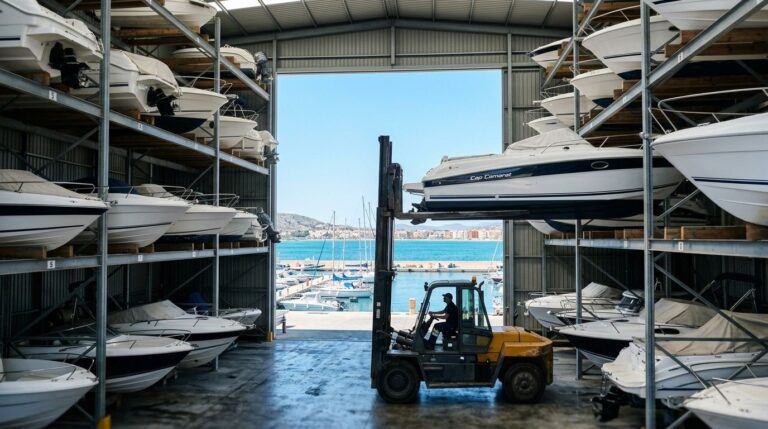
Out of the water on hard standing, a boat lift or dry stack is the best option for long lay-ups. The hull is protected from growth and osmosis, there is no risk of sinking, and it is the perfect time for antifouling and anode replacement.
In the water is fine if the boat will still be used occasionally and someone checks it regularly. Run the engine to temperature every few weeks or, better still, take it out for a run.
Engine: inboards and sterndrives
- Change the oil and filter before lay-up, not after. Used oil contains acids that attack bearings when the engine sits for months.
- Flush the raw water system with fresh water, and on boats stored ashore, run through antifreeze or an inhibitor mixture. Even without frost, it stops salt crystallising and corrosion building up inside heat exchangers and exhaust elbows.
- Remove or slacken the raw water impeller so the vanes don’t take a permanent set. Many owners simply fit a new impeller in spring.
- Fog petrol engines. Spraying fogging oil into the intake protects the cylinders from corrosion.
- Check the coolant strength and condition on freshwater-cooled engines.
- Grease the steering, gimbal and drive components on sterndrives.
Outboards
- Flush thoroughly with fresh water.
- Change the lower unit gear oil and check for water.
- Fog the engine if the manufacturer recommends it.
- Disconnect the fuel line and run the carburettor dry on older carburetted engines. Modern fuel-injected outboards should be treated as the manual says.
- Store the engine tilted down if the boat is ashore, so water drains from the leg.
Fuel
Fill the tank to about 90% to reduce condensation, and add a quality stabiliser for petrol or a biocide for diesel. Run the engine briefly to get treated fuel through the system. Diesel bug thrives in warm climates and is a common cause of spring breakdowns here.
Batteries and electrics
- Fully charge the batteries, then either disconnect them or connect a smart maintenance charger if you have reliable shore power.
- Clean the terminals and spray them with a protective coating.
- Turn off everything except anything that truly needs power, such as an automatic bilge pump on a boat left afloat.
Interior and upholstery
Mould is the biggest winter enemy in a warm, damp coastal climate.
- Remove cushions and store them dry indoors if you can, or stand them on edge for air to circulate.
- Empty fridges and leave the doors open.
- Leave lockers and hatches ajar inside the boat, and use moisture absorbers.
- Empty and flush the water tanks and the holding tank.
Covers and security
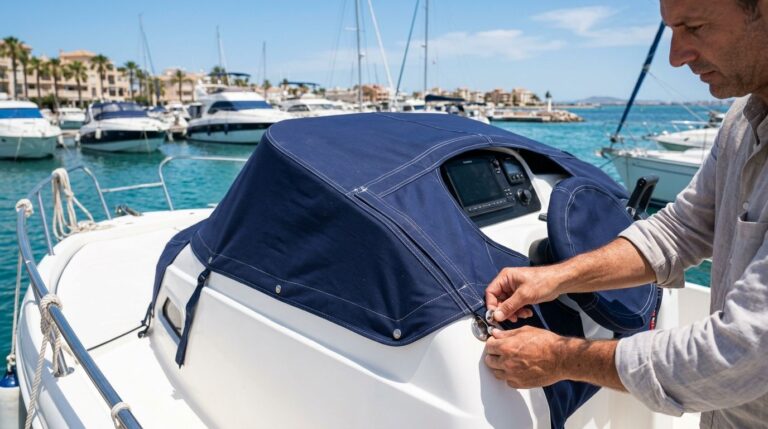
A good fitted cover keeps out sun, dust, rain and the occasional dose of Saharan dust that turns everything orange. Make sure it is ventilated so condensation can escape. Remove electronics that unclip easily, and keep a note of serial numbers for insurance.
Spring recommissioning
In spring, reverse the process: fit a new impeller if you removed the old one, check the belts and hoses, charge and refit the batteries, check the bellows and seacocks, antifoul if needed, and run a proper sea trial before the first family day out.
Let us do it for you
We offer a full winterisation and spring recommissioning package, along with boat lifts and storage. Take a look at our guide to boat covers too, or simply book your lay-up and we’ll take care of everything.