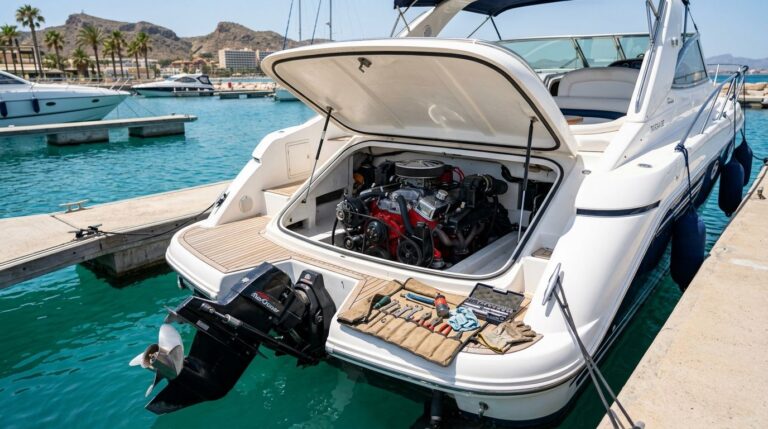
A well-maintained marine diesel can run for many thousands of hours. A neglected one can fail expensively in a single summer. On motor cruisers, flybridge boats and fishing boats of all sizes along this coast, the engines we work on most are from Volvo Penta, Yanmar, Cummins (including Cummins MerCruiser Diesel), Nanni and Perkins, with some older VM, FPT/Iveco and Caterpillar installations.
The diesel service in detail
- Engine oil and filters. Diesel oil gets dirty quickly from soot. Change it at the hours or annual interval in the manual.
- Fuel filters: primary filter and water separator, plus the engine-mounted secondary filter. Clean fuel is everything to a diesel.
- Air filter checked or replaced. Engine rooms are hot and can be dusty, especially after Saharan dust days.
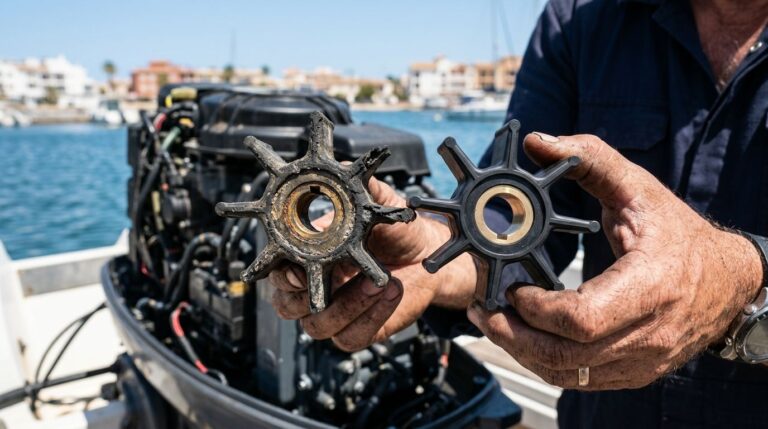
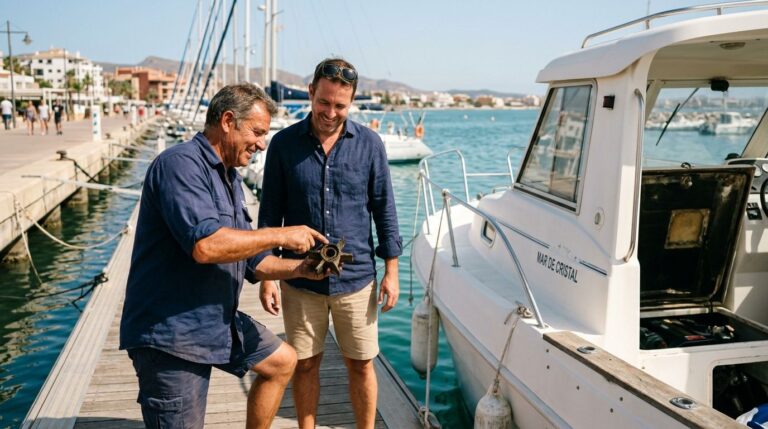
- Raw water impeller replaced.
- Heat exchanger, oil cooler, gearbox cooler and aftercooler inspected and cleaned when needed. On turbocharged engines, a fouled aftercooler reduces power and raises temperatures.
- Coolant checked and changed at the specified interval.
- Drive belts checked for tension and wear.
- Gearbox oil changed or checked.
- Engine mounts and shaft alignment checked on shaft-drive boats.
- Exhaust elbow and mixing elbow inspected for carbon build-up and corrosion.
- Anodes inside the heat exchanger (where fitted) as well as on the hull and shafts.
Brand notes
Volvo Penta (D1 and D2 smaller diesels, D3, D4, D6, older KAD and TAMD series). Excellent engines with good parts support in Spain. Older KAD engines have a mechanically driven compressor and a turbo, and need careful aftercooler and intercooler maintenance. Modern engines with EVC electronics need diagnostic software to read faults properly.
Yanmar (such as the 4JH, 6LY and 8LV series). Very reliable and economical. Keep an eye on the mixing elbow, the heat exchanger and the raw water pump. The 8LV is now common on mid-size sports boats with sterndrives.
Cummins and Cummins MerCruiser Diesel (QSD, QSB). Strong engines that need correct software diagnostics and clean fuel. Aftercoolers and heat exchangers need attention on higher-hour engines.
Nanni. Based on marinised Kubota, Toyota and John Deere blocks, Nanni engines are common on smaller cruisers and fishing boats. Parts are usually easy to find if you know the base engine.
Perkins (Sabre). Found on older motor cruisers, including some British-built boats. Robust, but now ageing, so hoses, mounts and cooling systems deserve close attention.
The big three diesel problems in the Med
1. Diesel bug. Microbial growth in the fuel thrives in the heat. It forms a dark sludge that blocks filters, usually at the worst moment. Prevention: keep the tank fairly full, drain the water separator regularly, use a biocide and change filters on time. If you already have it, the tank may need to be cleaned or the fuel polished.
2. Overheating. Usually a raw water problem: a worn impeller, a blocked strainer, scale in the heat exchanger or a blocked intake. Diesels also overheat when the propeller or hull is heavily fouled, because the engine works harder for the same speed.
3. Turbo and exhaust issues. Black smoke, loss of power or failure to reach maximum RPM can point to a fouled hull, a blocked air filter, a turbo problem or a restricted exhaust elbow. Diagnosis comes before replacement.
Signs to call us
- Black, white or blue smoke that isn’t normal for your engine.
- The engine won’t reach its rated maximum RPM.
- Rising temperatures, low oil pressure or alarms.
- Difficult starting, especially when hot.
- Oil or coolant in the bilge.
We service and diagnose marine diesels on craft of all sizes. See our boat servicing and fault finding pages, or book a diesel service.