Bayliner, Sea Ray, Four Winns, Chaparral, Glastron, Rinker and many European sports cruisers left the factory with a petrol engine driving a sterndrive leg. The two names you will see on most of them are MerCruiser (from Mercury Marine) and Volvo Penta. Both are proven designs, but both need regular attention to stay reliable in salt water.
How a sterndrive works
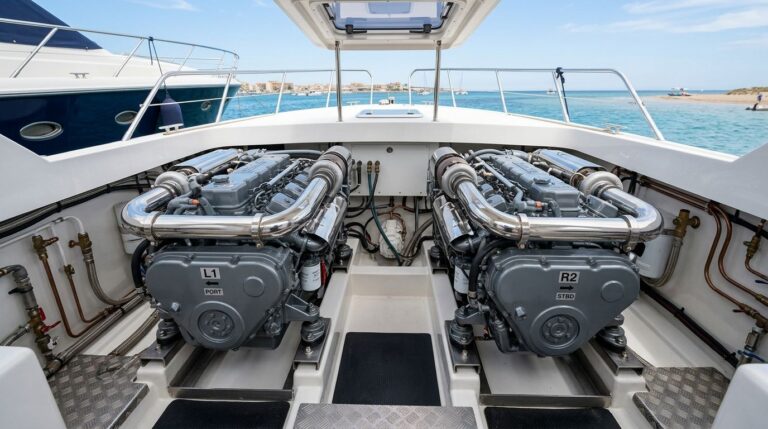
A sterndrive combines an inboard engine, often a GM-based V6 or V8, with an outdrive leg that passes through the transom. The leg steers and trims like an outboard. It is a clever arrangement, but it introduces some specific weak points: the bellows and seals where the drive passes through the transom, the gimbal bearing, the exhaust manifolds and the drive’s own gears.
What a sterndrive service should include
- Engine oil and filter.
- Fuel filter and water separator.
- Spark plugs, distributor cap and rotor on older engines.
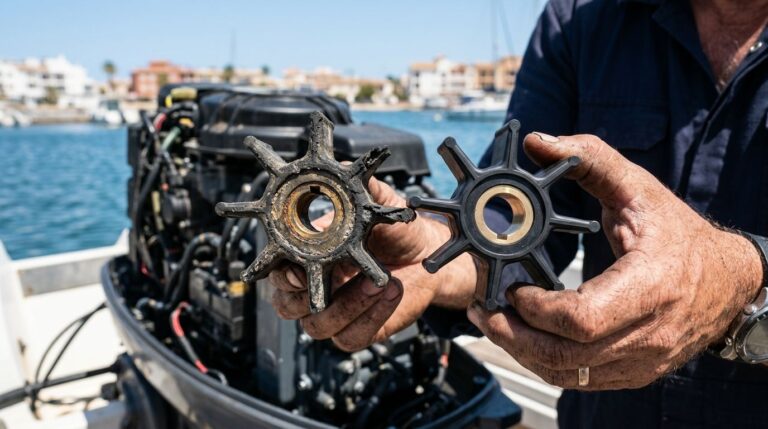
- Raw water impeller (on MerCruiser Bravo drives this sits in the engine-mounted pump; on Alpha drives and many Volvo Penta legs, the impeller is in the leg itself).
- Drive oil change, with a check for water.
- Bellows inspection: drive shaft bellows, exhaust bellows and shift cable bellows.
- Gimbal bearing and universal joints checked and greased, which normally requires the drive to be removed every few years.
- Exhaust manifolds and elbows inspected.
- Anodes on the leg, transom assembly and trim tabs.
- Trim and tilt fluid and rams.
- Belts, hoses and clamps.
The failures we see most
Exhaust manifold and riser corrosion. On raw water cooled petrol engines, salt water runs through cast iron manifolds and elbows. Over time they corrode internally, and eventually water can get back into the engine. That is one of the most expensive failures a sterndrive owner can suffer, and it is usually preventable. Manifolds and risers should be inspected and replaced before they fail; on salt water engines they are a wear item, not a lifetime part.
Split bellows. The rubber bellows that seal the drive to the transom perish in heat and UV. A split bellow can let water into the boat, and in the worst case sink it at the mooring. We recommend replacing them every few years as a preventive measure.
Water in the drive oil. Milky drive oil means a seal is letting water in. Caught early, it is a seal kit. Ignored, it destroys the gears and bearings.
Gimbal bearing wear. A rumbling noise when turning the drive by hand, or a growl at low speed, can mean the gimbal bearing is failing. Regular greasing extends its life.
Overheating. Usually caused by a worn impeller, a blocked strainer or debris in the leg’s water intakes. In the Mar Menor, weed and sand are frequent culprits.
Closed cooling conversions
Many owners convert raw water cooled petrol engines to closed (freshwater) cooling. Coolant circulates through the engine and manifolds, while salt water only passes through a heat exchanger. It costs more up front but dramatically extends the life of the engine block and manifolds in salt water. If you’re keeping a petrol sterndrive boat for the long term, it’s worth discussing.
Diesel sterndrives
Volvo Penta’s diesel range (such as the D3, D4 and D6) and older Cummins MerCruiser and VM diesels are also common on sterndrives. They follow a similar drive service with a diesel-specific engine service. We cover them in our marine diesel guide.
Book a sterndrive service
We service MerCruiser Alpha and Bravo drives and Volvo Penta SX, DP and DPS drives, at your berth or on the hard. Read about our boat servicing or request a quote.